
competitive-programming2022년 3월 6일2분 분량
[LeetCode] 714. Best Time to Buy and Sell Stock with Transaction Fee 풀이
수정일: 2022년 3월 6일
Dynamic programmingMathGreedy
지원 언어:enko
#Problem
714. Best Time to Buy and Sell Stock with Transaction Fee
#Approach
#Solution 1: DP
두 가지 상태가 존재하며, 이는 다음과 같이 표현할 수 있습니다.
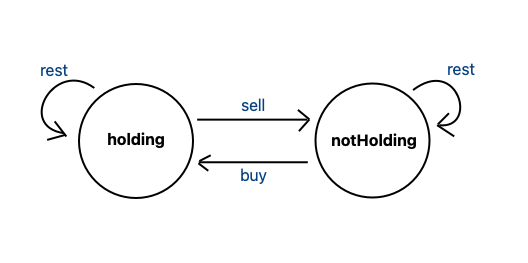
따라서 상태 전이를 표현하여 이 문제에 dynamic programming 접근법을 사용할 수 있습니다.
holding[i]= max(holding[i-1],notHolding[i-1]- prices[i])notHolding[i]= max(notHolding[i-1],holding[i-1]+ prices[i] - fee )
base case를 초기화하는 것은 어렵지 않습니다.
holding[0]= -prices[0]notHolding[0]= 0
최종 정답은 입니다.
Note
공간 복잡도를 로 최적화할 수 있습니다. 아래 구현이 이를 수행합니다.
#Solution 2: DP & Greedy
예제 테스트 케이스가 많은 것을 알려줍니다.
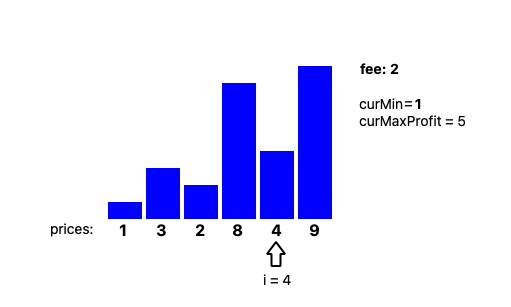
왼쪽에서 오른쪽으로, 다음 정의에 따라 값들을 갱신합니다.
i: 현재 인덱스curMin: 지금까지의 최소 가격curMaxProfit: 지금까지의 최대 이익
i=4라고 하면, curMin은 1이 되고 curMaxProfit = 8 - 1 - 2(fee) = 5가 됩니다.
여기서 우리는 price[4]를 살지 말지 결정해야 하며, 다음 조건일 때 사는 것이 항상 최적입니다.
여기서 P는 미래의 어떤 아주 큰 가격을 나타냅니다.
따라서 위 조건을 확인하여 greedy 방식으로 살 가격들을 고를 수 있습니다.
왼쪽에서 오른쪽으로,
- 만약 이면, ans +=
curMaxProfit. 이제 prices[i]가 새로운curMin이 됩니다. - 그렇지 않고 prices[i] <
curMin이면,curMin값을 갱신합니다. - 그 외에는
curMaxProfit값을 갱신합니다
#Code
#Solution 1: DP

typedef vector<int> vi;

class Solution {
public:
    int maxProfit(vi &prices, int fee) {
        int n= prices.size(), holding= -prices[0], notHolding= 0;
        for (int i=1; i < n; ++i) {
            int prevHolding= holding;
            holding= max(prevHolding, notHolding-prices[i]);
            notHolding= max(notHolding, prevHolding+prices[i]-fee);
        }
        return max(holding, notHolding);
    }
};
#Solution 2: DP & Greedy

typedef vector<int> vi;

class Solution {
public:
    int maxProfit(vi &prices, int fee) {
        int n= prices.size(), curMin= prices[0], curMaxProfit= 0, ans= 0;
        for (int i=1; i < n; ++i) {
            if (curMin + curMaxProfit > prices[i]) {
                ans += curMaxProfit;
                curMin= prices[i];
                curMaxProfit= 0;
            }
            else if (prices[i] < curMin) curMin= prices[i];
            else curMaxProfit= max(curMaxProfit, prices[i]-curMin-fee);
        }
        ans += curMaxProfit;
        return ans;
    }
};
#Complexity
#Solution 1
- Time:
- Space:
#Solution 2
- Time:
- Space: