
[Design Pattern] MVC
Updated: Mar 10, 2024
#Design Patterns
A collection of the BP (Best Practices) used by object-oriented developers. They contain solutions to problems faced during development, obtained over a long period through trial & error.
#What is the MVC Pattern?
Model + View + Controller
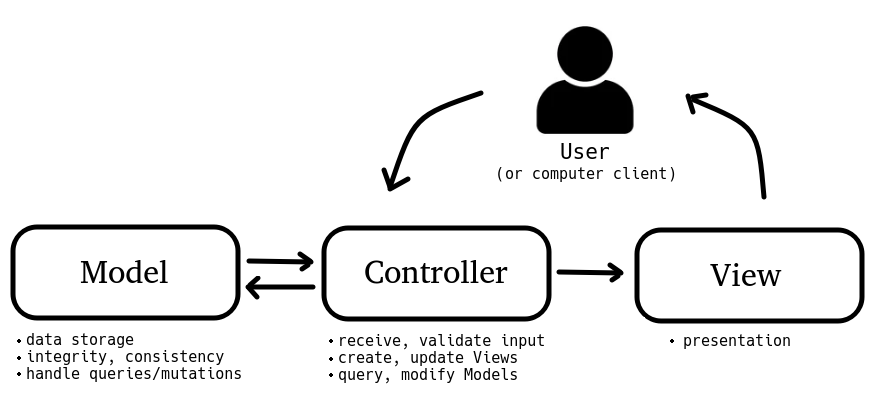
A pattern that divides the composition of an application into three concerns.
By separating the UI shown to the user from the Business Logic, you can build an application in which each can be easily modified without affecting the other.
#🎈Model
The part that handles data and its processing
- An object, or a Java POJO.
- It must not have internal attributes that reference the View or the Controller (to prevent direct modification).
- The part that notifies the Controller when a change occurs must be implemented.
#🎈View
The part that composes the screen
- An element that represents the data held by the Model.
- It must not store data separately, and should merely represent the data it receives.
- The part that queries the Model to update itself must be implemented.
#🎈Controller
The part that receives and processes user input
- The role of receiving user input and validating it.
- It controls the data flow going into the Model, and each time a change occurs in the Model, it selects the View to be updated.
- In doing so, it plays the role of separating the Model and the View.
- It monitors changes in the Model and the View.
#Order of Operation
- The Controller detects and validates user input
- The Controller identifies the action and performs the business logic (manipulating the Model).
- The Controller selects the View to be shown after that action
- The View displays the screen using the Model
Because the Controller's role ends at selecting the View to show, the View fetches data using the Model's methods.
#3 Ways to Update the View
- Directly using the Model class
- The Model notifies the Views registered as its Observers
(Observer pattern). - Detecting changes & updating through the View's polling
#Characteristics of the MVC Pattern
The relationship between Controller and View is not 1:1 but 1:N.
Therefore, the larger the application grows, the heavier the Controller's burden becomes, and this can become a bottleneck.
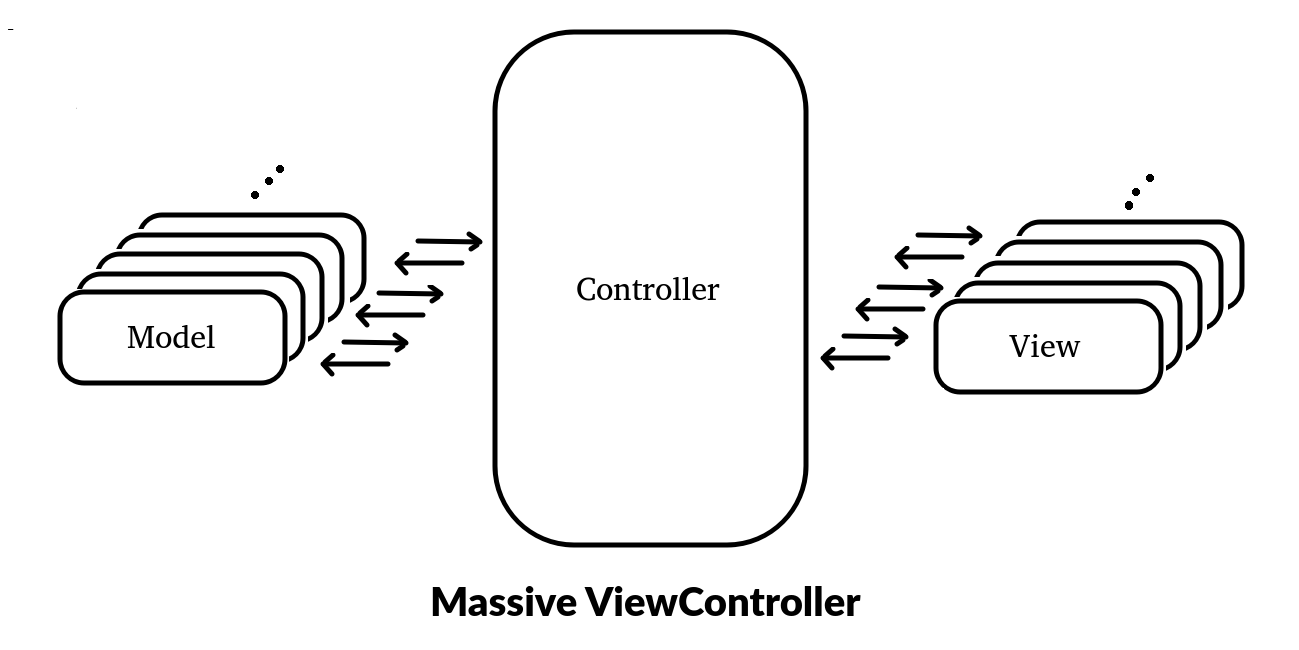
Satirizing this situation, it is called a Massive ViewController (the initials happen to be the same).
And because the structure has the View use the Model when it needs to update, it can be said to be a pattern with high coupling between the Model and the View.