
[LeetCode] 714. Best Time to Buy and Sell Stock with Transaction Fee explained
Updated: Mar 6, 2022
#Problem
714. Best Time to Buy and Sell Stock with Transaction Fee
#Approach
#Solution 1: DP
There exists 2 states, and those can be expressed as:
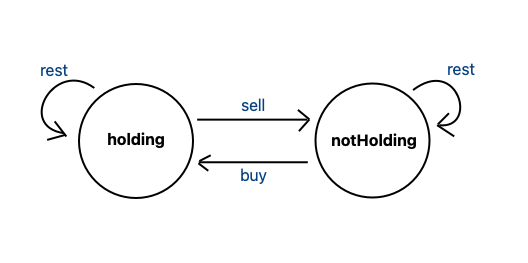
Hence, we can use dynamic programming approach to this problem, representing state transfers.
holding[i]= max(holding[i-1],notHolding[i-1]- prices[i])notHolding[i]= max(notHolding[i-1],holding[i-1]+ prices[i] - fee )
Initializing base case shouldn't be difficult,
holding[0]= -prices[0]notHolding[0]= 0
The ultimate answer is .
Note
We can optimize space complexity into . Implementation below does that.
#Solution 2: DP & Greedy
Example test cases tell us many things.
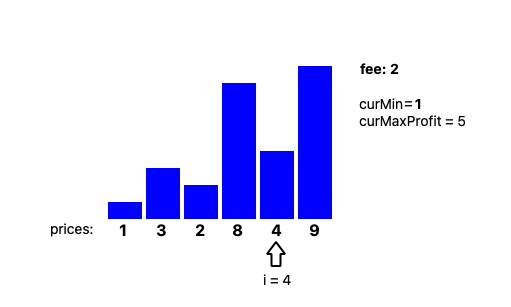
From left to right, update those values with following definitions.
i: current indexcurMin: minimum price so farcurMaxProfit: maximum profit so far
Say i=4, then curMin becomes 1 and curMaxProfit = 8 - 1 - 2(fee) = 5.
Here we need to decide wether to buy price[4] or not and it is always optimal to buy it when:
where P denotes some huge price in the future.
Thus, we can pick prices to buy in a greedy way, by checking the above condition.
From left to right,
- if , then ans +=
curMaxProfit. prices[i] is a newcurMinnow. - else if prices[i] <
curMin, updatecurMinvalue. - else update
curMaxProfitvalue
#Code
#Solution 1: DP

typedef vector<int> vi;

class Solution {
public:
    int maxProfit(vi &prices, int fee) {
        int n= prices.size(), holding= -prices[0], notHolding= 0;
        for (int i=1; i < n; ++i) {
            int prevHolding= holding;
            holding= max(prevHolding, notHolding-prices[i]);
            notHolding= max(notHolding, prevHolding+prices[i]-fee);
        }
        return max(holding, notHolding);
    }
};
#Solution 2: DP & Greedy

typedef vector<int> vi;

class Solution {
public:
    int maxProfit(vi &prices, int fee) {
        int n= prices.size(), curMin= prices[0], curMaxProfit= 0, ans= 0;
        for (int i=1; i < n; ++i) {
            if (curMin + curMaxProfit > prices[i]) {
                ans += curMaxProfit;
                curMin= prices[i];
                curMaxProfit= 0;
            }
            else if (prices[i] < curMin) curMin= prices[i];
            else curMaxProfit= max(curMaxProfit, prices[i]-curMin-fee);
        }
        ans += curMaxProfit;
        return ans;
    }
};
#Complexity
#Solution 1
- Time:
- Space:
#Solution 2
- Time:
- Space: