
competitive-programmingFeb 16, 20221 min read
[LeetCode] 53. Maximum Subarray explained
Updated: Feb 15, 2022
Dynamic programmingDivide and conquer
Available in:enko
#Problem
#Approach
#Solution 1: DP
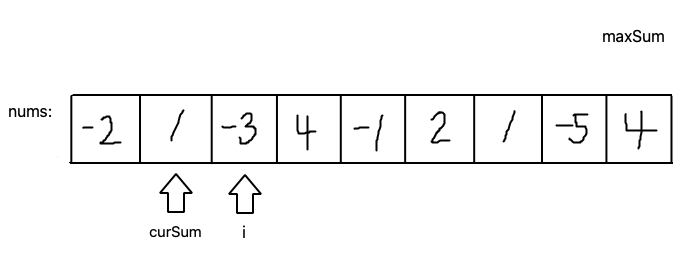
One pass from left to right.
While iterating the nums array, update curSum value with larger of those two.
- nums[i]
- curSum + nums[i]
The answer maxSum is the maximum value among all curSums.
#Solution 2: Divide and conquer
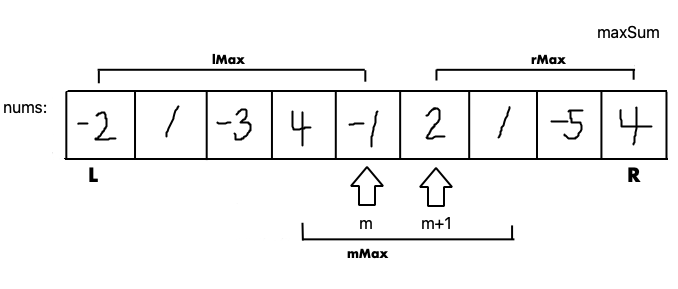
Think of the answer maxSum in a subarray nums[L:R]. It's among those three.
- sum of subarray containing values
nums[m]andnums[m+1](mMax) maxSumin subarraynums[L:m](lMax)maxSumin subarraynums[m+1:R](rMax)
All we have to do is:
- calculate the mMax
- find
maxSumin left and right subarrays (recursive call) - return max among those three
#Code
#Solution 1: DP

typedef vector<int> vi;

class Solution {
private:
    const int NEG_INF= -1e5;
public:
    int maxSubArray(vi &nums) {
        int n= nums.size(), ans= NEG_INF, curSum= NEG_INF;
        for (int i=0; i < n; ++i) {
            curSum= max(nums[i], curSum+nums[i]);
            ans= max(ans, curSum);
        }
        return ans;
    }
};
#Solution 2: Divide and conquer

typedef vector<int> vi;

class Solution {
private:
    int maxSum(vi &nums, int L, int R) {
        if (L >= R) return nums[L];
        int m= L-(L-R)/2;
        // calculate maxSubarray containing nums[m] to the left
        int mMaxL= nums[m], lSum= nums[m];
        for (int i=m-1; i >= L; --i) {
            lSum += nums[i];
            mMaxL= max(mMaxL, lSum);
        }
        // calculate maxSubarray containing nums[m+1] to the right
        int mMaxR= nums[m+1], rSum= nums[m+1];
        for (int i=m+2; i <= R; ++i) {
            rSum += nums[i];
            mMaxR= max(mMaxR, rSum);
        }
        int mMax= mMaxL+mMaxR;
        return max( mMax, max( maxSum(nums, L, m), maxSum(nums, m+1, R) ) );
    }

public:
    int maxSubArray(vi &nums) {
        int n= nums.size();
        return maxSum(nums, 0, n-1);
    }
};
#Complexity
#Solution 1
- Time:
- Space:
#Solution 2
- Time:
- Space: