
[Algorithms] Bitmask
Updated: Mar 12, 2022
A way to handle sets efficiently in both memory and time.
We use the binary representation of an integer as a data structure.
To represent the subset of the set , we get .
#1. Advantages
#Fast operation speed
Most operations have a time complexity of O(1).
e.g.) To check whether a specific element exists, there is no need for a linear search—just check whether the result of the AND operation is greater than 0.
#Memory efficient
The bool type in vector<bool> is allocated 1 byte, but since only 1 bit is used to store true or false, the remaining 7 bits are wasted.
#Since arrays are replaced by integers, they can be used as an index
Strictly speaking, C++ STL's map<T,T> container also allows vector<T> as the key type, so an array form isn't entirely unusable as an index.
However, representing an array with a bitmask and using it as a key yields a more concise result.
Suppose we have a cache variable that has array-form keys.
map<vector<bool>,int> cache;
Using a bitmask, it becomes this concise.
map<int,int> cache;
int cache[];
#2. Bit Operations
#Basics
a & b    // AND    000101 & 000011 = 000001
a | b    // OR     000101 |  000011 = 000111
a ^ b    // XOR    000101 ^ 000011 = 000110
~a       // NOT   ~000101 = 111010
a << b   // SHIFT  000101 << 000011 = 101000
a >> b   // SHIFT  000101 >> 000011 = 000000
#Common mistakes
Forgetting operator precedence
bool a = (6 & 3 == 2);
// a = 0 (the comparison operator "==" is evaluated first.)
Overlooking integer overflow
bool isFlagUpBad(uint64_t a, int idx) {
  return (a & (1 << idx)) > 0;
} // 1 is of type int. If idx is greater than 32, overflow occurs.

bool isFlagUpGood(uint64_t a, int idx) {
  return (a & (1ull << idx)) > 0;
} // Still constrained: idx < 64
#3. Representing a Set
There is a pizza with 20 kinds of toppings.
#Empty set and full set
uint32_t dough = 0;
// 0000 0000 0000 0000 0000 0000 0000 0000
uint32_t fullPizza = (1 << 20)-1;
// 0000 0000 0000 0000 0000 0000 0000 0001
// 0000 0000 0001 0000 0000 0000 0000 0000
// 0000 0000 0000 1111 1111 1111 1111 1111
#Adding an element
pizza |= (1 << toppingIdx);
#Checking whether an element exists
if (pizza & (1 << hamIdx)) {
  cout << "My pizza has ham on it !!\n"; // good
}

if ((pizza & (1 << hamIdx)) == 1) {
  cout << "naa..\n"; // bad. The result of the & operation is not 1.
}
#Removing an element
pizza &= ~(1 << toppingIdx);  // good
pizza -= (1 << toppingIdx);   // bad. If that bit was originally 0, you get a nonsensical value.
#Toggling an element
pizza ^= (1 << toppingIdx);
#Set operations
uint32_t unionSet = a | b;      // union
uint32_t intersection = a & b;  // intersection
uint32_t removed = a & ~b;      // difference
uint32_t xor = a ^ b;           // the union minus the intersection
#Counting the number of elements
Shift the bits to the right one at a time while counting the number of 1s.
int howManyToppings(uint32_t s) {
  int sz= 0;
  while (s) {
    sz += (s&1);
    s >>= 1;
  }
  return sz;
}
You can also do it recursively.
int howManyToppings2(uint32_t s) {
  if (s == 0) return 0;
  return (s & 1) + howManyToppings2(s >> 1);
}
#Finding the least element
uint32_t firstTopping= pizza & -pizza;
//          pizza = 01101100
//         -pizza = 10010100    two's complement
// pizza & -pizza = 00000100
#Clearing the least element
uint32_t removed = pizza & (pizza-1);
//             pizza = 01101100
//           pizza-1 = 01101011
// pizza & (pizza-1) = 01101000
#Iterating over subsets excluding the empty set
uint32_t pizza;
for (int subset= pizza; subset; subset= (subset-1) & pizza) {
  // do something with subset
}
// subset = 01101100
// subset = 01101000
// subset = 01100100
// subset = 01100000
// subset = 01001100
// subset = 01001000
// subset = 01000100
// subset = 01000000
// subset = 00101100
// subset = 00101000
// subset = 00100100
// subset = 00100000
// subset = 00001100
// subset = 00001000
// subset = 00000100
#4. Simple Examples
#15 Puzzle
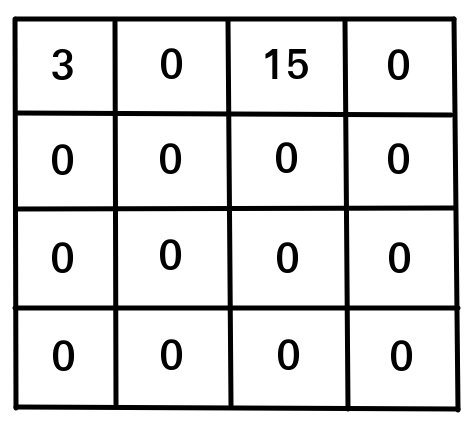
Let's represent a 4x4 puzzle whose cells hold values from 0 to 15. The first representation that comes to mind is a 2D array.
int arr[4][4];
Since it only holds values in the range 0-15, 4 bits each is enough. Reducing the size,
char arr[4][4];
The char type is 1 byte, so it still wastes 4 bits,
and crucially, this way it is cumbersome to use this state as an index.
4 bits x 16 = 64.
The cleanest approach is a bitmask of type uint64_t.
uint64_t bitmask;
Implementing a getter and setter to access the value of : labeling the bitmask
indices,
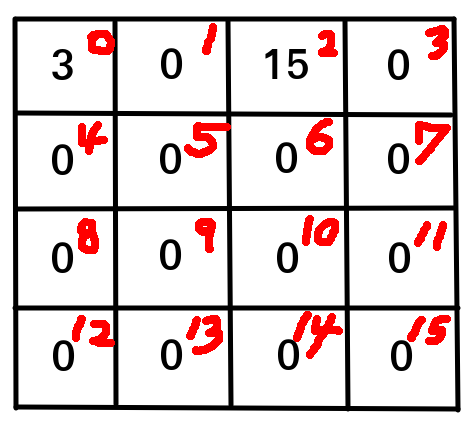
int getValue(uint64_t mask, int r, int c) {
  int idx= (r << 2) + c;
  return (mask >> (idx << 2)) & 15;
}

void setValue(uint64_t &mask, int r, int c, uint64_t value) {
  int idx= (r << 2) + c;
  mask= mask & ~(15ull << (idx << 2)) | (value << (idx << 2));
  //            ...111100001111...      ...0000{value}0000...
}